How to Convert/Recycling a PET Bottle into Yarn ?
 What is PET?
PET (polyethylene terephthalate) is a type of clear, durable, and versatile plastic. In fact, How to Convert Plastic PET Bottles to Yarn? it is the most recyclable and recycled plastic in the world. Manufacturers use PET resin to create transparent, light, shatterproof bottles for soft drinks, juices, alcohol, water, detergents, soap, and more. PET stands for polyethylene terephthalate. The primary application for PET is bottles, and it is fully recyclable.
Why is PET bottle recycling important?
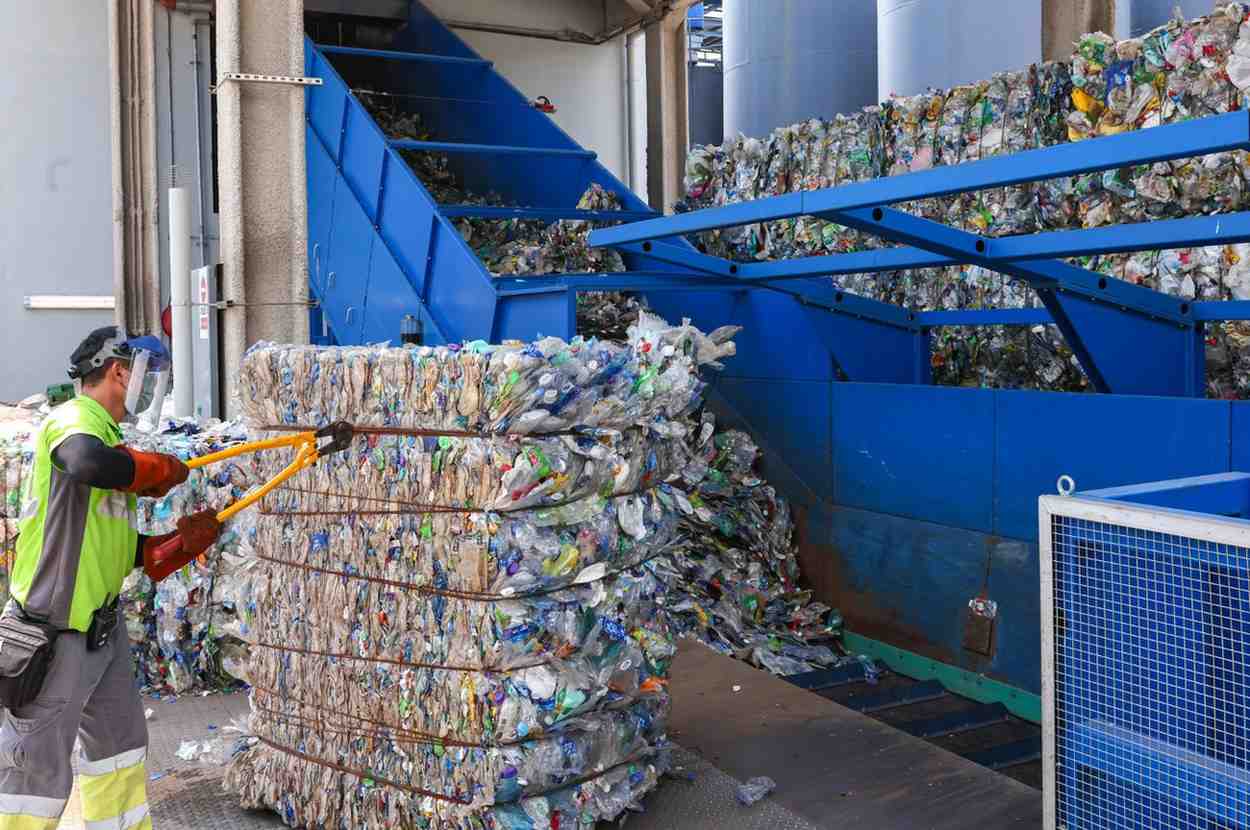
PET’s low melting temperature, relative to alternatives such as glass and aluminum, makes it easy and sustainable to turn PET packaging into more PET packaging in a closed loop. Every year, people across Europe collect billions of PET bottles, compress them into bales, and send them to recycling plants.
Energy Efficiency, Resource Conservation, and Reduced Carbon Footprint
This process consumes less energy and fewer resources compared to making products with virgin plastic. It also diverts bottles from landfills and keeps resources in the loop, thereby reducing environmental impact. Recycling PET bottles helps reduce greenhouse gas emissions by minimizing the need for virgin plastic production, thus contributing to a lower carbon footprint.
What type of plastic is available for recycling?
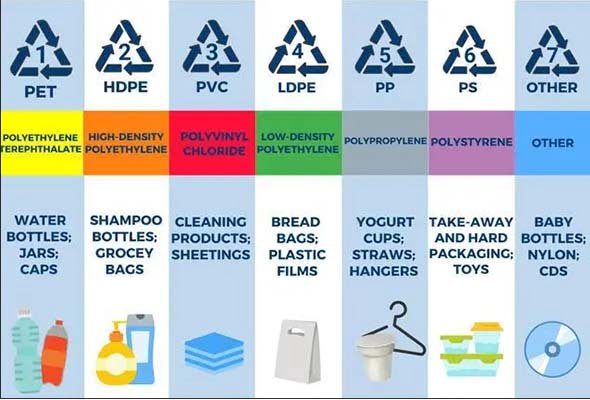
The following are the 7 types of plastics:
Polypropylene (PP)
take-out food containers, lunch boxes, ice cream containers
Polystyrene (PS)
plastic cutlery or foam hot drink cups
Plasticized Polyvinyl Chloride or Polyvinyl Chloride (PVC)
juice or squeeze bottles
Low-density Polyethylene (LDPE)
garbage bags
Polyethylene Terephthalate (PET)
soft drink bottles
High-density Polyethylene (HDPE)
milk bottles or shampoo containers
Miscellaneous Plastics
(Polycarbonate, Polylactide, Acrylic, Acrylonitrile butadiene, Styrene, Fiberglass, and Nylon)
Which plastics are feasible for recycling?
Currently, curbside recycling programs recycle only HDPE, PET, and PVC plastic products. However, they do not recycle PS, PP, and LDPE. These materials typically get stuck in the sorting equipment, causing it to stop or break.
Small Plastics, Wraps, Bags, Foam, Containers, Packaging, Polycarbonate, and BPA
People cannot recycle small plastics, plastic wraps, plastic bags, wrappers, polystyrene foam, deodorant containers, flexible packaging, polycarbonate, and BPA through curbside programs. Additionally, bottle tops and lids are not recyclable. Furthermore, recycling certain types of plastics is not economically feasible.
The Method of Recycling Process:
There are two main types of PET recycling: mechanical and chemical. Among these, mechanical recycling is the most widely used. Specifically, this process produces clean PET flakes that can be used directly or mixed with virgin polymer in subsequent transformation processes to obtain other end products..
Chemical Recycling:
This process involves transesterification with alkoxide catalysts. Workers combine the PET raw material with an alcohol and the catalyst, then treat it thermally. The reaction produces a terephthalic ester and ethylene glycol.
Mechanical Recycling:
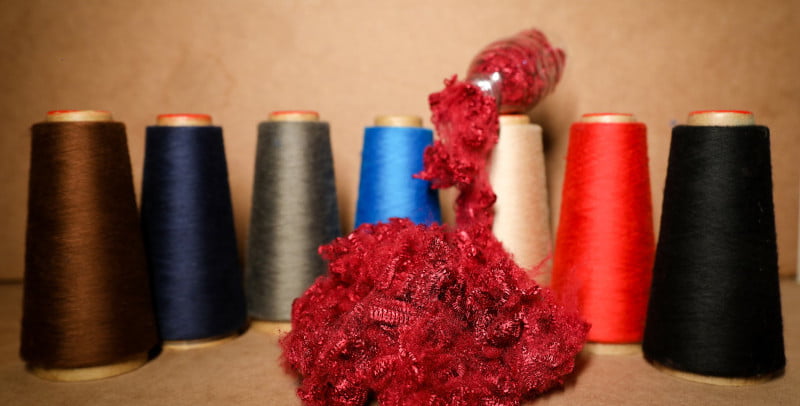
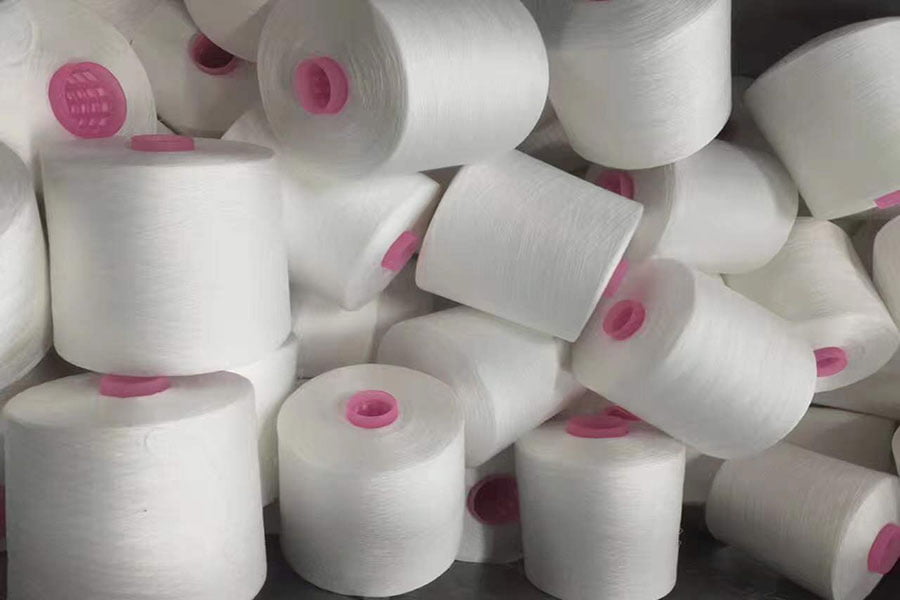
Workers heat the flakes to eliminate the last impurities, then melt and transform them into dense pellets. Afterward, they melt the pellets again and extrude them into rough polyester fiber. Next, they brush, stretch, and spin the fiber into yarn. Finally, the yarn undergoes processing into various types of fabric.
How do you turn plastic bottles into polyester yarn?
Workers separate the bottles by color, with clear bottles producing white polyester yarn and green bottles producing greenish yarn. Next, they grind these sorted bottles into small flakes, toss them in hot air to give them a hard coating, and then melt them into a thick liquid.
Forming Fine Filaments, Spooling, and Weaving
They pass this liquid through plates with small holes, forming filaments less than five times finer than a human hair. Next, machines spool the yarn over hot metal rollers to stretch it and realign the polyester. Finally, workers weave the resulting yarn into polyester clothing.
How do you process PET recycling?
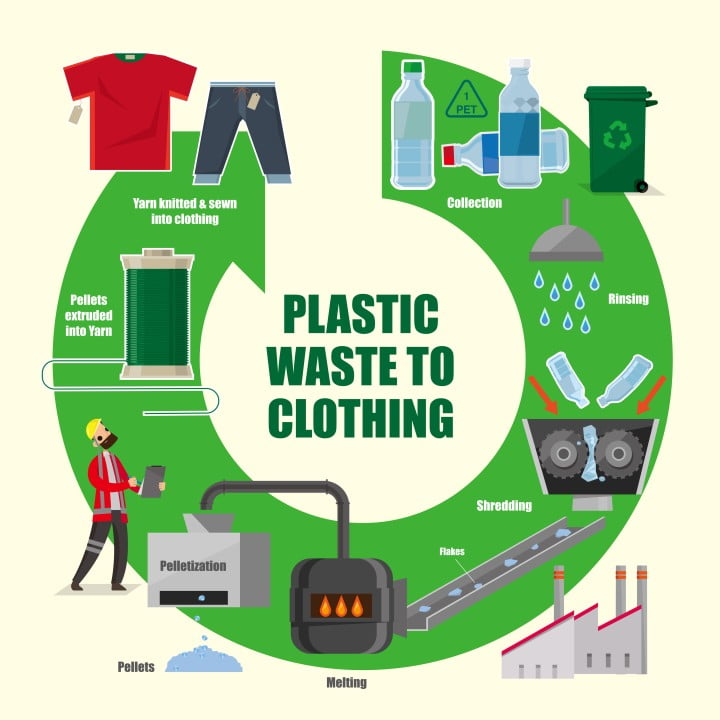
Collects PET bottles:
PET bottles serve many purposes, including holding pesticides, water, chemicals, and juices. Local street hawkers collect PET bottles and sell them to recyclers. Moreover, if brands want to use sustainable recycled yarn, they must initiate plastic collection from the ground up. This process involves setting up dustbins and conducting awareness activities. The hawkers then gather bottles from the field and supply them to local recyclers.
Sorting:
The main sorting of PET bottles is done by local small crushing factories. All the plastic bottles are separated from other plastics according to color, type, and transparency in a material recovery facility. Laborers sit with separate baskets and sort into different baskets.
Crush:
Jaw crushers often crush larger plastic bottles. Meanwhile, hydraulic crushers use hydraulic pressure to crush plastic bottles. Shear shredders or grinders are better for breaking down hard, bulky, or thick plastics, while granulators handle thin plastics and molded parts more effectively. The process crushes the plastic bottles into small sizes, and hydraulic machines deliver these pieces to a water-filled container. After washing and cleaning, the small pieces of plastic dry.
Polymerization:
This condensation polymerization process of Bis(2-hydroxyethyl) Terephthalate takes place in a vacuum at 530 degrees Fahrenheit, producing chains of PET and ethylene glycol. Workers constantly remove ethylene glycol during the polymerization process and use it to make additional PET.
Condensation and Addition Polymerization.
Furthermore, polymerization can proceed through two mechanisms: condensation polymerization and addition polymerization. In addition polymerization, the reaction successively adds monomer molecules to the reactive end (e.g., a radical end) of a growing polymer chain.
How to make polyester chips?
Manufacturers source the raw materials for producing PET chips, PTA (purified terephthalic acid) and MEG (monoethylene glycol), from petroleum. Specifically, they produce PET chips by granulating polyester.
Forming Polyester and Producing Textile Chips
This polyester forms through a polycondensation reaction of purified terephthalic acid (PTA) and mono-ethylene glycol (MEG). They produce these chips for textile applications and supply them to the yarn-producing industry in semi-dull and bright luster. So, how do you convert plastic PET bottles to yarn?
How to manufacture polyester fiber/polyester filament:
Creating a Monomer: The process begins with the reaction of ethylene glycol with dimethyl terephthalate at high heat, resulting in a monomer.
Creating a Polymer:
Further addition of dimethyl terephthalate with the resulting monomer creates a polymer.
Extruding:
This molten polyester polymer is extruded from the reaction chamber in long strips, allowed to cool and dry, and then broken into small pieces.
Spinning:
Polyester goes through a melt spinning system, where the resulting chips melt again to create a honey-like substance. This substance is then extruded through spinnerets to form fibers. Next, the fibers transfer to a winding machine, producing a sliver that looks like noodles. Subsequently, the slivers move to the creel stage, the first stage of the drawing section.
From Slivers to Final Product
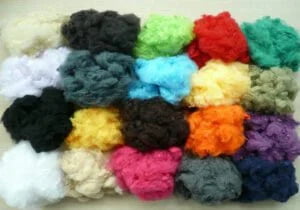
In the roller of the drawing machine, the slivers draft in several steps using chemicals such as lubricants and titanium dioxide. Consequently, this process yields 1.4 denier primary fiber. Next, the primary fiber automatically runs into the dryer, where it becomes moisture-free and smooth. Afterward, it transfers to the cutting machine, which cuts it into the desired length according to buyer requirements, resulting in smooth polyester staple fibers.
Staple Recycle Fiber:
Dried flakes are melted and molded into the desired shape or further processed into granules. The flakes are melted with regulated temperatures using specialized equipment to ensure they are not destroyed.
Identification and Classification:
In this step, workers test small plastic particles to determine their quality and class. The first test checks density by placing the particles in a large tank of water; denser particles sink, and less dense ones float.
Determining Particle Thickness, Melting Point, and Color
The next test, air classification, determines the thickness of the particles by dropping them into a wind tunnel; larger particles remain lower, while smaller particles rise higher. Additionally, workers analyze sample particles from each batch for their melting point and color.
Compounding or Extruding:
In this step, shredded plastic is melted and extruded into pellets used for future plastic product production.
Why recycle plastic PET?
Reduces Pollution:
Recycling plastic instead of producing it from scratch significantly reduces toxic greenhouse gas emissions. Additionally, improper disposal of plastic waste can contaminate soil and water, which harms wildlife. In contrast, recycling sends plastic to proper centers, where workers process and make it reusable efficiently.
Conserves Energy:
Producing one ton of plastic requires almost 5,774 kilowatt-hours of energy, 16 barrels of oil, 1,000 to 2,000 gallons of gasoline, and 30.4 cubic yards of landfill space. In contrast, recycling plastic can save up to 66% of the energy and conserve non-renewable resources. Furthermore, recycling plastic helps save approximately 7.4 cubic meters of landfill space per ton of plastic.
Decreases Demand for Fossil Fuel:
Recycling plastic reduces the demand for non-renewable resources such as fossil fuel, crude oil, natural gas, and coal.
Increases Employment Opportunities:
Collecting and recycling plastics generate jobs and create new business opportunities, which improve the economy and living standards.
Advantages:
The production of recycled polyester yarn uses 2/3 less energy and almost 90% less water than virgin polyester production. No new petroleum is required, reducing environmental impact.
What can be saved by plastic recycling?
Landfill:
Eight plastic drink bottles are kept out of landfill for each meter of polar fleece made from 80% recycled PET bottles.Fossil Fuels:
Virgin polyester is derived from petroleum, so recycling saves on fossil fuels.Patagonia’s Impact:
Patagonia estimates that 25 drink bottles go into each jacket, saving a barrel of oil and avoiding half a ton of toxic air emissions compared to virgin polyester production.
Key Facts:
- 10 plastic bottles = 1 pound of polyester fiber
- Recycling 1 ton (2,000 lbs) of plastic bottles saves 3.8 barrels of oil
- Recycling 1 million plastic bottles saves 250 barrels of oil
- Recycling 1 million plastic bottles eliminates 180 metric tons of CO2 emissions
- 10% of all US oil consumption (2 million barrels per day) is used to make plastics
The Energy and Environmental Savings of Recycling Plastic Bottles
- Recycling plastic bottles takes 8 times less energy than producing new ones
- 150 fleece garments made from recycled bottles save 1 barrel of oil
- 500 t-shirts made from recycled bottles save 1 barrel of oil
- 50 backpacks made from recycled bottles save 1 barrel of oil
- Supplying the plastic bottles Americans consume each year requires 47 million barrels of oil and releases 1.0 billion pounds of CO2
The Construction Capabilities of Fiber and Yarn:
- Fibers: All natural and manmade fibers and blends
- Open-End: .4Ne to 14Ne or .67Nm to 23.6Nm in singles and plies
- DREF Spun: Customized solutions and proprietary capabilities
- Twisting: Up to 16 components
Global Statistics:
In 2011, the world collected approximately 7.5 million tons of PET, which resulted in 5.9 million tons of flakes. In comparison, in 2009, manufacturers used 3.4 million tons of PET to produce fiber, 500,000 tons for bottles, 500,000 tons for APET sheets used in thermoforming, 200,000 tons for strapping tape, and 100,000 tons for miscellaneous applications (Source: PCI).
1.6 Million Tons Collected in 2011 and 81% Recycled in Switzerland in 2012
In 2011, Europe alone collected 1.6 million tons of PET bottles, and producers generated 1.12 million tons of PET flake after accounting for exported bales (Source: PCI for Petcore and EuPR). Additionally, in 2012, 81% of the PET bottles sold in Switzerland were recycled.
Recycled PET bottles used for a range of items:
Recycled PET bottles can be recycled back into bottles, but the fiber market is currently the major outlet. Fibers from recycled PET bottles are used to make clothing and carpeting.
Successful Yarn Applications:
- Colored recycled fiber blends producing economical colorfast yarns
- Integrating recycled fibers in the yarn center to create a core filler
- Matching a recycled fiber percentage within a high value, yet economical performance blend
- Optimizing a higher valued recycled fiber percentage in a commodity-driven yarn to enhance product value without significant price disruptions
Wow, fantastic blog format! How lengthy have you been bloging for?
yoou made running a blog look easy. The full look of your web site is excellent,
let alone the content! https://Odessaforum.Biz.ua
Wow, fantastic blog format! How lengthy have youu been blogging for?
you made running a blog look easy.The full look of your web site is excellent, let alone the content! https://Odessaforum.Biz.ua
Pingback: World Oceans Day 2024: Awaken New Depths - Carbon Revolve
I am not certain where you are getting your info, but great topic. I needs to spend a while studying much more or understanding more. Thank you for excellent info I was looking for this information for my mission.